
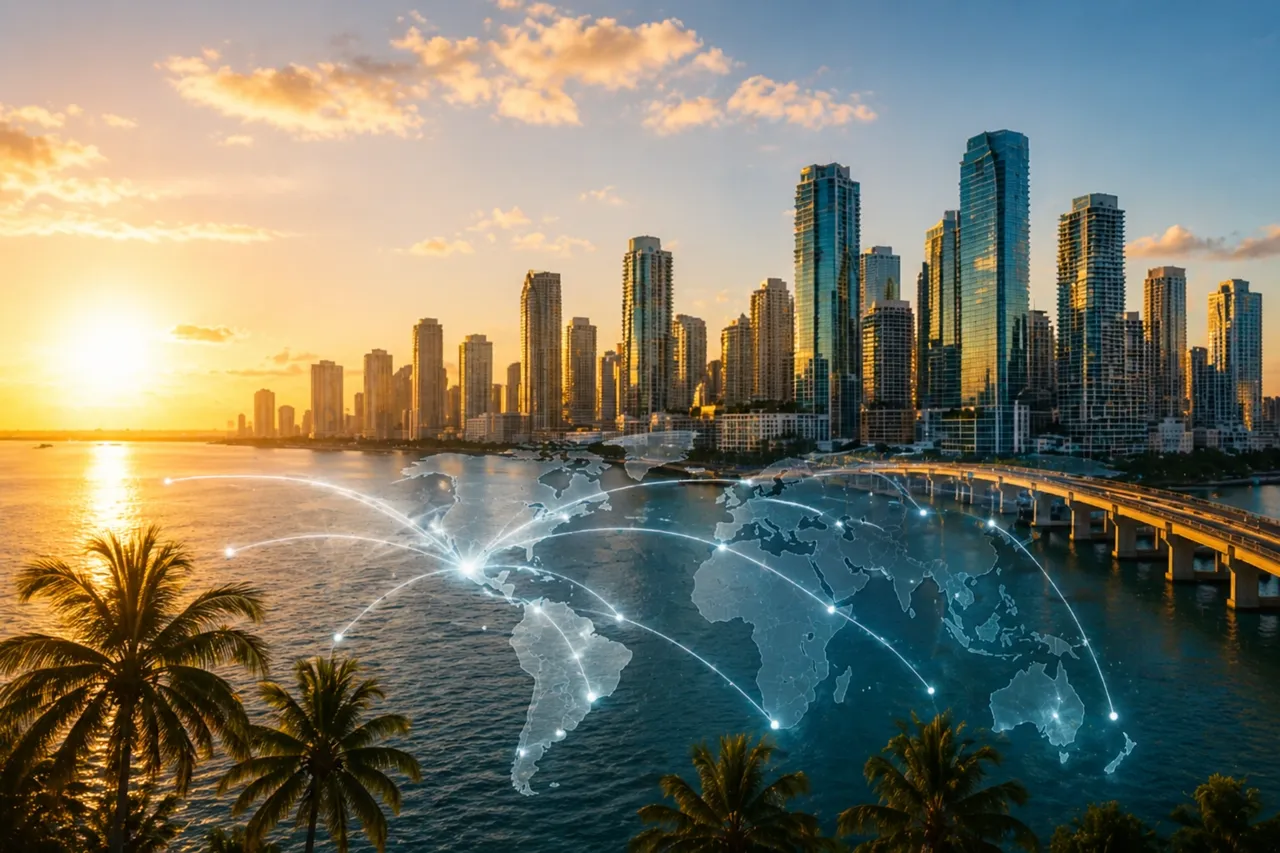
From the “Miami Experience” to projects delivered on time and on budget.
For decades, Miami has carried the nickname “Capital of Latin America.” But today, that nickname means something entirely different.
What began as an attractive destination for its location, its climate, and the famous “shopping” has transformed into an economic, financial, and strategic hub with local, regional, and global influence.
The “Miami Experience” has also evolved. Today it is not a slogan. It is a business model.
A model built on its greatest asset: the opportunity to take part in an ecosystem where capital, talent, and decisions that impact projects across Latin America converge.
Capital arrives in Miami. Talent relocates to Miami. Companies expand toward Miami.
Few cities offer a similar combination of opportunity, connectivity, legal stability, and multicultural affinity. That is why it has become the natural point of entry for Latin American investors, developers, and operators.
But there is one reality that does not change. Opportunity does not build projects. Execution does. And that is where the conversation has to become more precise.
Because the very factors that make Miami attractive also raise the bar. Costs are higher, labor is more limited, regulation is more complex, timelines are less flexible, and the expectations of investors and lenders are significantly more demanding.
The “Miami Experience” is not achieved through intention. It is achieved through disciplined execution.
For many Latin American players, Miami represents expansion. But expanding without adapting is not expansion. It is a risk.
What works in Bogotá, Mexico City, or Lima does not automatically translate to the U.S. market. Not in the contractual structure. Not in risk allocation. Not in the way conflicts are managed during execution.
Here, discipline is not optional.
Projects demand greater foresight, better structuring, and a real capacity to manage uncertainty in real time.
Because in Miami, problems do not disappear. They become more visible, faster, and more costly. And that completely changes the way they must be approached.
If Miami is the capital of Latin America, it is also the place where dreams and market analysis only have value if they translate into projects delivered on time and on budget.
It is not just about arriving. It is about knowing how to execute.