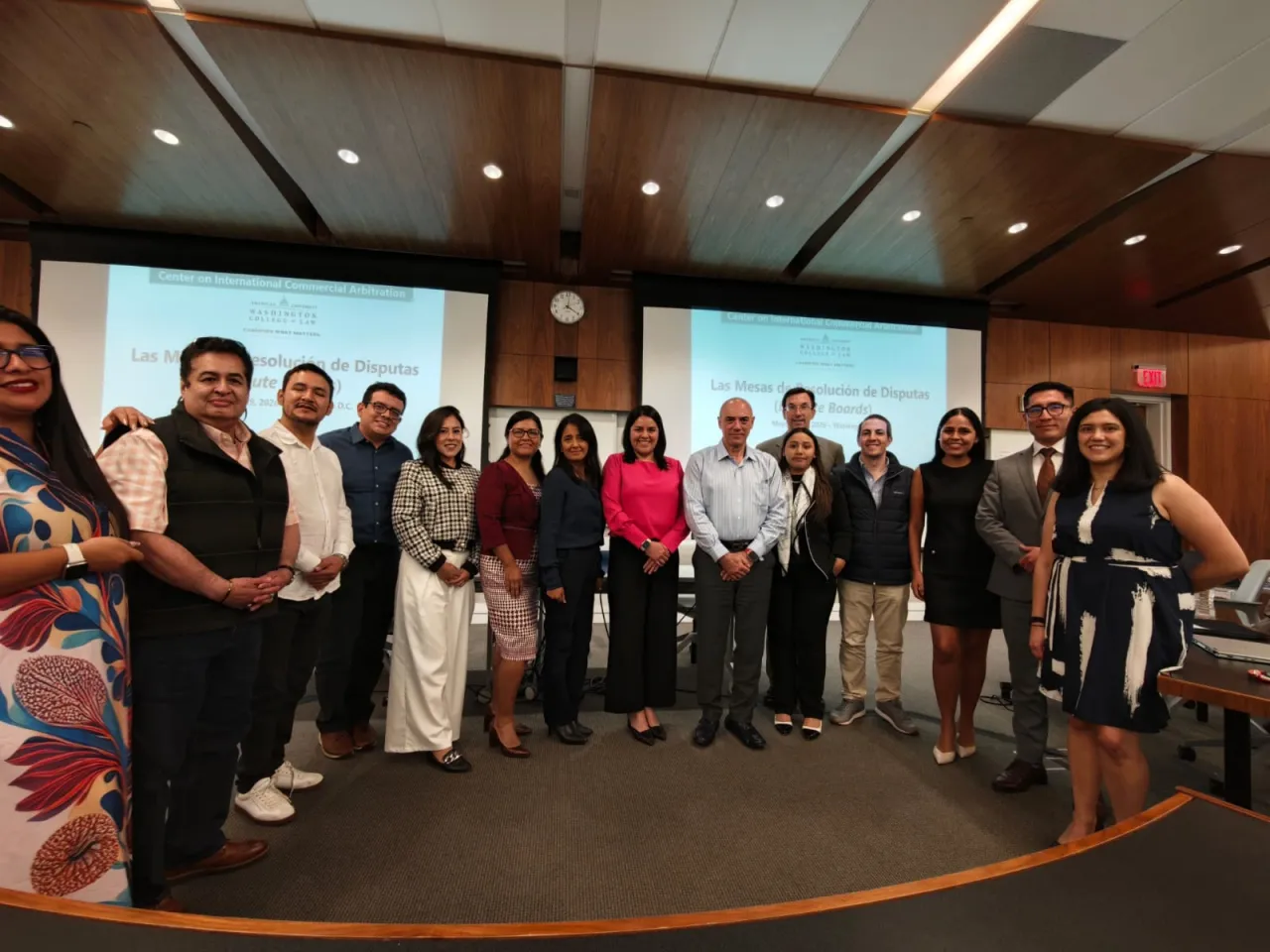
On May 26, I returned to American University Washington College of Law to teach a new edition of the course on Dispute Boards, developed jointly by the university and the Dispute Resolution Board Foundation (DRBF).
Every year this experience leaves me with an enormous dose of optimism.
Most of the participants come from Latin America, especially from Peru, Costa Rica, and Mexico. Many are public officials, engineers, lawyers, and infrastructure professionals who already work on, or are seeking to get involved in, projects where dispute boards are gaining more and more relevance.
What impresses me most is the level of commitment of these students. Many personally finance their participation in the program. They do not come because it is a requirement. They come because they want to learn, grow professionally, and return to their countries with tools that allow them to deliver better projects and resolve conflicts more efficiently.
During the course we analyze how different Latin American jurisdictions have adopted dispute boards. Peru occupies a prominent place in these conversations, as it has incorporated this mechanism into its regulatory framework for public projects. We also discuss experiences in other countries in the region, some very successful and others that reveal the risks of departing from international best practices.
One of the most enriching aspects is hearing the perspectives of professionals who face real challenges in their countries. The conversations go far beyond theory. We talk about projects, institutions, public procurement, and how to prevent conflicts from paralyzing works that are fundamental to the development of our communities.
I was also fortunate to have the visit of Adrián Bastianelli, one of the most respected figures in construction law and alternative dispute resolution in the United States. His reflections on the importance of protecting projects, beyond simply resolving disputes, were an invaluable lesson for everyone present.
For me, teaching this course has a very special meaning. There are few opportunities to teach these topics in Spanish to a Latin American audience so committed and so eager to generate positive change in their regions.
I left Peru at the age of 18 and have been fortunate to build an international career that has allowed me to learn from great professionals and take part in extraordinary projects. Being able to share those experiences today with those who will apply this knowledge in Latin America is one of the most rewarding ways I have found to give back some of everything I have received.
It is, quite simply, my way of contributing a grain of sand.