
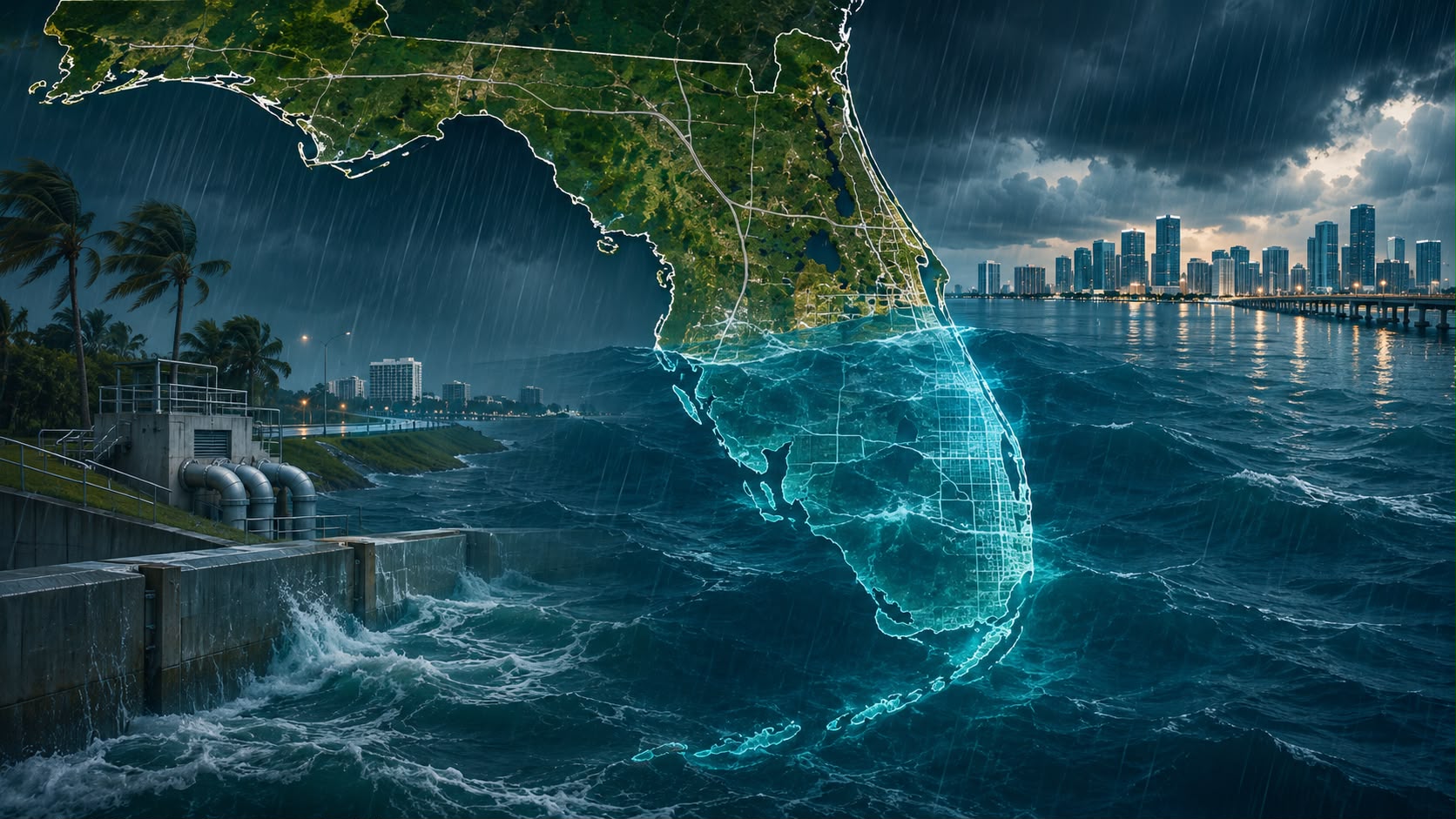
Anyone who has spent enough time in South Florida has seen it: a perfectly sunny day, no rain in sight, and water begins appearing where it does not belong.
Streets flood. Garages become inaccessible. Storm drains struggle. Waterfront properties suddenly find the line between land and Biscayne Bay considerably less clear.
These are not necessarily weather-related flooding events. During king tides, unusually high ocean levels push water onto streets and properties, even on bright, sunny days. As sea levels rise, flooding that once occurred only under exceptional conditions has become increasingly frequent.
What may seem like a temporary inconvenience illustrates a much larger problem.
Flooding in South Florida — video via X (@Whi_rlz)
Watch the video on X →
For South Florida’s developers, contractors and property owners, rising water levels present an enormous challenge, one that extends far beyond engineering. Every adaptation project will involve questions about financing, contractual responsibilities, risk allocation and potentially significant disputes.
And the questions looming over all of it are: Who is going to pay to adapt the buildings and infrastructure we already have? And who is capable of undertaking such a monumental project?
The Problem Is Bigger Than the Building
Miami-Dade County’s planning projections anticipate sea levels 10 to 17 inches higher by 2040 compared with 2000 levels. Addressing the consequences could require higher roads, improved drainage, pump stations, seawalls, floodproofing and significant modifications to existing structures.
There are two distinct challenges: prevention and mitigation.
Preventive measures seek to reduce flooding through drainage improvements, seawalls and other protective infrastructure. Mitigation and adaptation measures address the consequences of water exposure that cannot be entirely prevented.
For existing buildings, the second challenge may prove particularly complicated.
Consider a waterfront condominium built decades ago. The structure itself may remain sound, but the conditions around it are changing.
The road providing access floods more frequently. The garage entrance sits too low. Electrical and mechanical equipment becomes increasingly vulnerable. Drainage infrastructure requires improvement.
Eventually, areas originally designed as usable ground-floor space may require substantial modification and could, in some cases, become increasingly vulnerable to flooding. Parking facilities, receiving areas, lobbies and other essential building functions could become increasingly difficult or costly to maintain.
This ongoing phenomenon poses a particularly significant challenge for some of the most valuable waterfront properties in our state.
In some cases, solutions may involve flood barriers or relocating critical equipment. In others, more extensive structural intervention may be required. Elevating certain existing structures may be technically possible, but for larger buildings, the engineering and financial challenges could make such an approach impractical.
Building differently from the beginning is one thing.
Retrofitting an existing city is something entirely different.
And unlike an isolated construction project, the effectiveness of these improvements may depend on infrastructure beyond the property itself.
A condominium association could invest millions of dollars in protecting its building, only to find that the surrounding public roads remain vulnerable. A developer constructing a neighboring property to newer resilience standards may encounter entirely different elevation and drainage conditions.
Water does not recognize property lines. Neither can the solutions.
Who Bears the Financial and Contractual Responsibility?
The engineering challenges are substantial. The financial and legal implications may be even greater.
A condominium association may need millions of dollars for improvements its owners never contemplated when purchasing their units. Special assessments could place considerable pressure on residents already facing rising insurance, maintenance and building compliance expenses.
And these are the associations that can afford the retrofit. What about those that cannot?
Municipalities face their own financial constraints. Raising roads, upgrading drainage systems and strengthening coastal infrastructure require significant public investment.
Developers can incorporate resilience measures into new construction, but they cannot independently address the vulnerabilities of neighboring properties or public infrastructure.
Contractors can execute the solutions engineers design, but increasingly complex retrofit projects introduce additional technical, scheduling and contractual risks, along with significant expenses.
And no single party controls the entire system.
This creates an important legal question: How should responsibility be allocated when the success of one construction project depends on improvements that fall outside the control of its owner, designer or contractor?
Construction contracts are designed to define responsibilities, allocate foreseeable risks and establish procedures for handling unexpected conditions. But adapting existing coastal infrastructure introduces challenges that may not fit within traditional project boundaries.
Who assumes responsibility when unforeseen site conditions require additional work? How should delays caused by dependent infrastructure improvements be addressed? What happens when the original scope must change to accommodate updated flood projections or design requirements?
These questions affect construction budgets, schedules, insurance requirements and the financial feasibility of projects long before disputes reach a courtroom or arbitration proceeding.
Today’s Solutions May Not Be Tomorrow’s Answers
South Florida is already investing in infrastructure improvements intended to reduce flooding.
These efforts are necessary, but they also raise a difficult long-term question: What happens when today’s improvements are no longer sufficient?
A drainage system upgraded to accommodate current conditions may require additional capacity as water levels continue to rise. A seawall raised today may eventually need further modifications. Building-level protections designed around existing projections may need to be reassessed decades later.
The issue is not that these improvements lack value. It is that adapting to rising sea levels is an ongoing process rather than a problem that can necessarily be solved through one construction project.
What works for the next 20 years may not be sufficient for the decades that follow.
For construction professionals, this presents a particular challenge. Projects must be designed, priced and delivered according to defined requirements, yet the environmental conditions they are intended to address will continue to evolve.
Contracts must therefore clearly establish the assumptions underlying the work, the responsibilities of each participant and the procedures for addressing changes.
Without that clarity, disagreements over project scope, performance expectations, additional costs and liability could become increasingly difficult to resolve.
Preventing the Next Generation of Construction Disputes
As South Florida undertakes more complex resilience projects, the potential for construction disputes will grow.
Consider a property owner investing in drainage improvements that affect water conditions on an adjacent site. Or a contractor completing a flood-protection project according to approved plans, only for changing environmental conditions to challenge its performance years later.
Who bears responsibility?
What happens when private developments depend on public infrastructure improvements that are delayed, never completed or simply do not work?
And when multiple owners, contractors, engineers and public agencies are involved, how should responsibilities for cost, scope and performance be allocated?
There will not be one universal answer. Each project will present its own contractual arrangements, technical considerations and legal obligations.
However, clear risk allocation, careful contract drafting, early coordination and effective dispute-prevention mechanisms can help reduce uncertainty.
For complex projects involving multiple stakeholders, addressing potential conflicts during planning and procurement may be far more effective than attempting to resolve them after construction has begun.
The objective should not simply be to determine who is liable when something goes wrong. It should be to establish a framework that allows projects to move forward while minimizing the likelihood of costly disputes.
A Challenge No Single Entity Can Solve
South Florida has spent generations engineering a way of life around water.
The next chapter will require adapting an existing built environment to conditions that continue to change. The scale of that undertaking could exceed the resources and capabilities of any single municipality, government agency, developer or private organization.
There will not be one seawall, one construction project or one funding source capable of addressing every vulnerability.
Instead, there will be thousands of decisions involving property owners, developers, condominium associations, contractors, engineers, lenders and public agencies.
Some improvements will address immediate needs. Others will require long-term planning and coordination across property boundaries and jurisdictions.
The challenge is not to suggest that every building will need to be elevated or that every street will eventually flood. It is to recognize that adapting an existing urban environment will require substantial investment, complicated construction projects and carefully defined legal relationships among those responsible for delivering them.
The question is no longer simply whether South Florida needs to adapt.
It is who pays for the work, who performs it, who assumes the risks and how disputes will be prevented or resolved when responsibilities overlap.
Those are conversations the construction and real estate industries should be having now, while there is still an opportunity to resolve them through planning, collaboration and sound contractual arrangements rather than across the table in costly disputes.